
Autauga County Arrest Records and Court Charges
Arrest records in Autauga County begin on the law-enforcement and jail side. They may identify the person arrested, arresting agency, booking event, initial allegation, bond or custody status, and release or transfer information when that information is public. The Autauga County Sheriff's Office operates from 162 W 4th Street in Prattville, and Metro Jail is the local custody facility for city and county inmates. A booking record can explain current custody, but it does not by itself prove guilt or show the final court outcome.
The Autauga County Sheriff's Office recent-news index shows the sheriff's public-facing information channel.
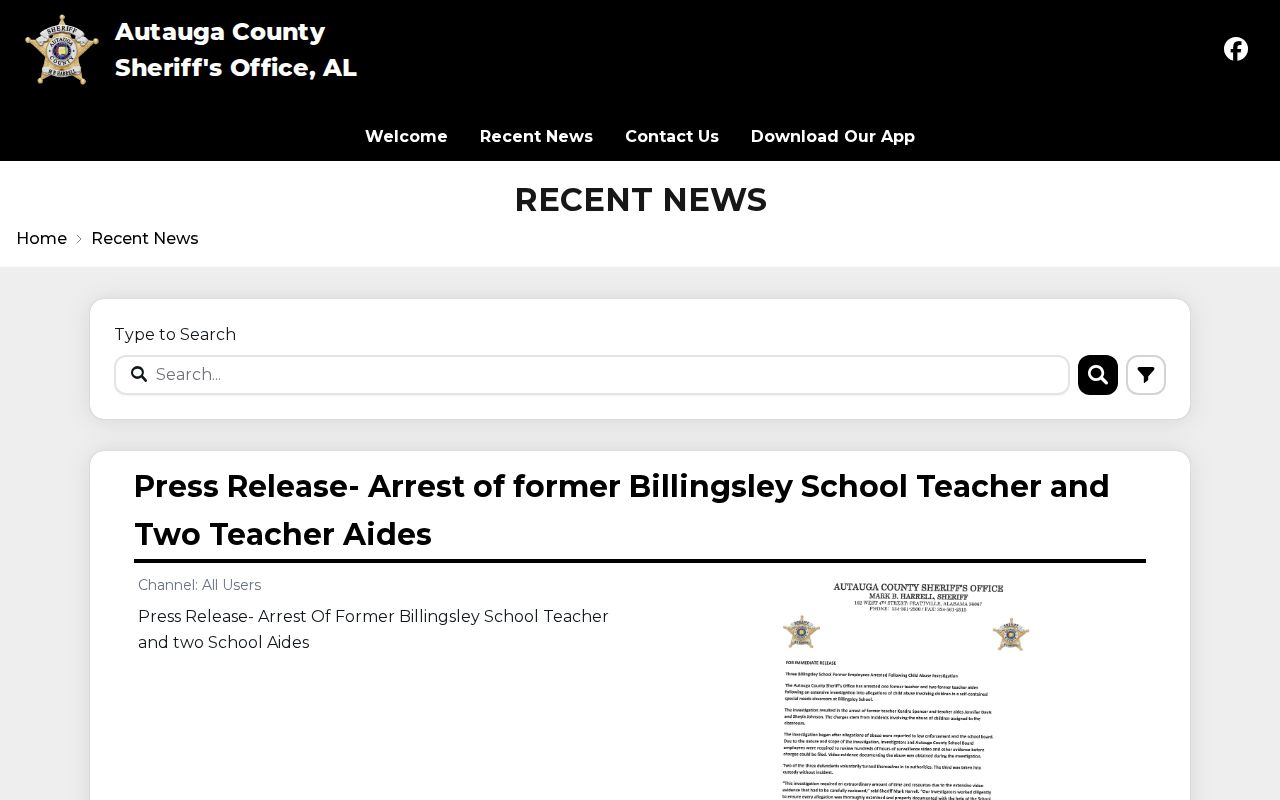
Sheriff news can provide public-safety context, but court charges and dispositions must be verified through court records.
Court charge records begin when the allegation is placed into the court system. Autauga's Circuit Criminal cases cover felony prosecutions, while District Criminal covers misdemeanors, preliminary felony matters, traffic-adjacent criminal cases, and some guilty pleas in felony cases not punishable by death. A charge record is the accusation or count level: charge description, statute or code, classification, plea, status, and disposition. The full criminal case file adds docket actions, hearings, orders, sentencing, costs, probation, and final outcome.
Arrest Record vs. Charge Record
The key distinction is custody versus prosecution. A sheriff or police booking record answers where the person entered custody and what was recorded at intake. A court charge record answers what formal accusations were filed and how those charges moved through District Court or Circuit Court. One arrest can lead to no charge, one charge, several counts, amended charges, a grand-jury indictment, or dismissal.
| Record Type | Primary Office | What It Usually Shows | Where to Verify |
|---|---|---|---|
| Arrest / booking record | Sheriff, police, Metro Jail | Booking, custody, initial allegation, bond or release information when public | Sheriff's Office, Metro Jail, sheriff app if roster is available |
| Court charge record | Circuit Clerk / court | Complaint, indictment, charge/count, statute, plea, status, disposition | Alacourt, public docket, Circuit Clerk criminal divisions |
| Full criminal case file | Circuit Clerk / court | Docket actions, hearings, orders, plea, sentence, costs, probation | Criminal court records and clerk copy request |
How to Find Autauga County Arrest Records and Charges
Start with the record type. For current custody or booking, use the inmate-record path: the sheriff app may show the current jail roster under Metro Jail, and the Sheriff's Office can answer custody questions at (334) 361-2500. For court charges after arrest, use the Circuit Clerk and Alacourt channels. The public docket page can help with setting dates, while Alacourt ACCESS and clerk contact can provide case detail or document images when available.
- Identify whether the question is about custody, charges, a court date, or final disposition.
- For custody, check the Autauga County Sheriff AL app or call the Sheriff's Office about Metro Jail.
- For charges, search Alacourt or the Autauga public docket by defendant name, case number, or setting date where available.
- Open the case detail and review each charge or count separately.
- Confirm amended, dismissed, convicted, or pending status with the Circuit Clerk when the online record is incomplete.
Criminal and traffic division contacts in Room 117 are important fallbacks: Circuit Criminal Vicky at (334) 358-6807 and District Criminal/Traffic Darlene at (334) 358-6802. Older, confidential, sealed, juvenile, or image-restricted records may require direct clerk handling rather than online access.
How Charges Get Filed After an Arrest: Complaint, Information, and Indictment
After an arrest, the initial jail allegation may not be the final court charge. The District Attorney, law enforcement, a magistrate, or a grand jury may shape the charge record depending on the offense and court level. Alabama trial-court records may include complaint, warrant, indictment, charge, bond, plea, docket action summary, orders, disposition, sentencing, financial obligations, and probation conditions.
| Charging Document | Who Creates or Presents It | Common Use | What to Check |
|---|---|---|---|
| Complaint | Law enforcement or prosecutor-supported filing | Misdemeanor, traffic-adjacent criminal, or initial criminal allegation | Charge description, case number, bond, first setting |
| Information | Prosecutor | Prosecutor-filed charging document in some criminal matters | Filed count, statute, amended language, plea status |
| Indictment | Grand jury | Felony prosecution after grand-jury action | Count list, felony classification, arraignment, Circuit Court case number |
| Warrant / capias | Judge, magistrate, or court | Arrest authority or failure-to-appear response | Issuing court, bond, active/recalled status |
District Attorney Review and Charge Changes
C.J. Robinson is District Attorney for Alabama's 19th Judicial Circuit, which includes Autauga County. The Autauga judiciary directory lists the District Attorney's Office in Room 106 with phone (334) 365-5715, and the Alabama District Attorneys Association directory lists C.J. Robinson for Circuit 19 with mailing address P.O. Box 700, Wetumpka, AL 36092-0700. The DA prosecutes state criminal cases, presents cases to the grand jury, handles felony and misdemeanor prosecution depending on court, and works with victims and witnesses.
The Federal Defenders for the Middle District of Alabama page is a separate federal defense resource.
Federal defender information matters only for federal cases; ordinary Autauga state charges are prosecuted through the state court system and the 19th Judicial Circuit DA.
An arrest charge may originate with law enforcement, then be reviewed, amended, reduced, dismissed, or replaced by prosecutors or a grand jury. That is why the initial booking allegation should not be treated as the final charge record. The court file is the better source for current charge language and status.
Charge Status and What It Means
Charge status can change as a criminal case moves through court. A charge may be pending at first appearance, amended by prosecutor action, reduced in a plea agreement, dismissed by the court, or resolved by plea, verdict, or other disposition. Each count should be read separately because one case can contain multiple charges with different outcomes.
| Status | What It Means |
|---|---|
| Pending | The charge has not reached final disposition and may still have hearings, plea negotiations, or trial settings. |
| Amended / Reduced | The charge language, statute, severity, or count has changed from the earlier allegation. |
| Dismissed with prejudice | The charge was dismissed and cannot be refiled in the same way. |
| Dismissed without prejudice | The charge was dismissed but may be refiled if law and facts allow. |
| Disposed / convicted | The count has reached a final outcome, often through plea, verdict, or sentencing. |
Charges vs. Convictions
Being charged is not the same as being convicted. A charge is an accusation filed in court. A conviction is a finding or plea of guilt. Background checks, court summaries, and online search results can blur this distinction, so read the disposition field and the docket actions before drawing conclusions.
| Charge | Conviction | |
|---|---|---|
| Stage | Accusation or count filed after arrest | Final guilt finding or guilty plea |
| Proof Level | Based on probable cause or prosecutorial filing standard | Based on plea or proof beyond a reasonable doubt |
| Record Meaning | Shows what was alleged and tracked by the court | Shows an adjudicated criminal outcome |
| Where to Confirm | Charge list, complaint, indictment, docket actions | Disposition, sentence, judgment, certified case action summary |
Sheriff Incident Reports and Warrant Path
Autauga's warrant page says that to obtain a warrant on an individual, a person must first have an Autauga County deputy sheriff complete an Incident/Offense Report and bring it to the Circuit Clerk's office. This connects sheriff incident records, warrant requests, and later court charges. It also means a warrant or arrest allegation may exist before the public court record shows a final charge status.
Failure-to-appear warrants can arise from traffic or criminal court dates. Autauga traffic instructions warn that failure to pay, dispose of a citation, or appear can result in an arrest warrant, ALEA license suspension, increased fine and cost, and bond forfeiture. Municipal citations may route to a city court and should not be assumed to appear in county records.
ALEA Sex Offender and Fugitive Limits
The ALEA Community Information Center provides statewide sex offender, fugitive, missing-person, and alert searches.
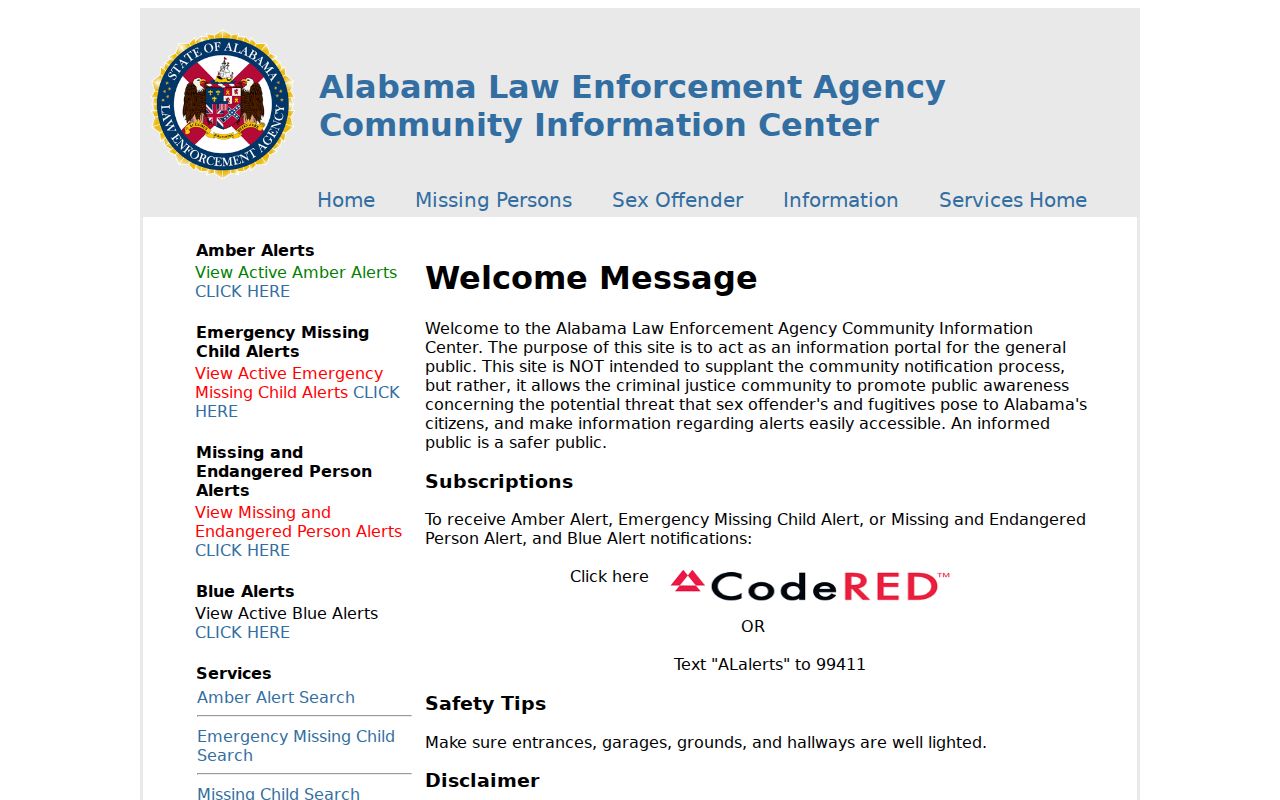
ALEA is useful for statewide public-safety searches, but it is not a complete Autauga court charge or arrest record database.
The ALEA Sex Offender Registry page explains the state repository and local registration forwarding.
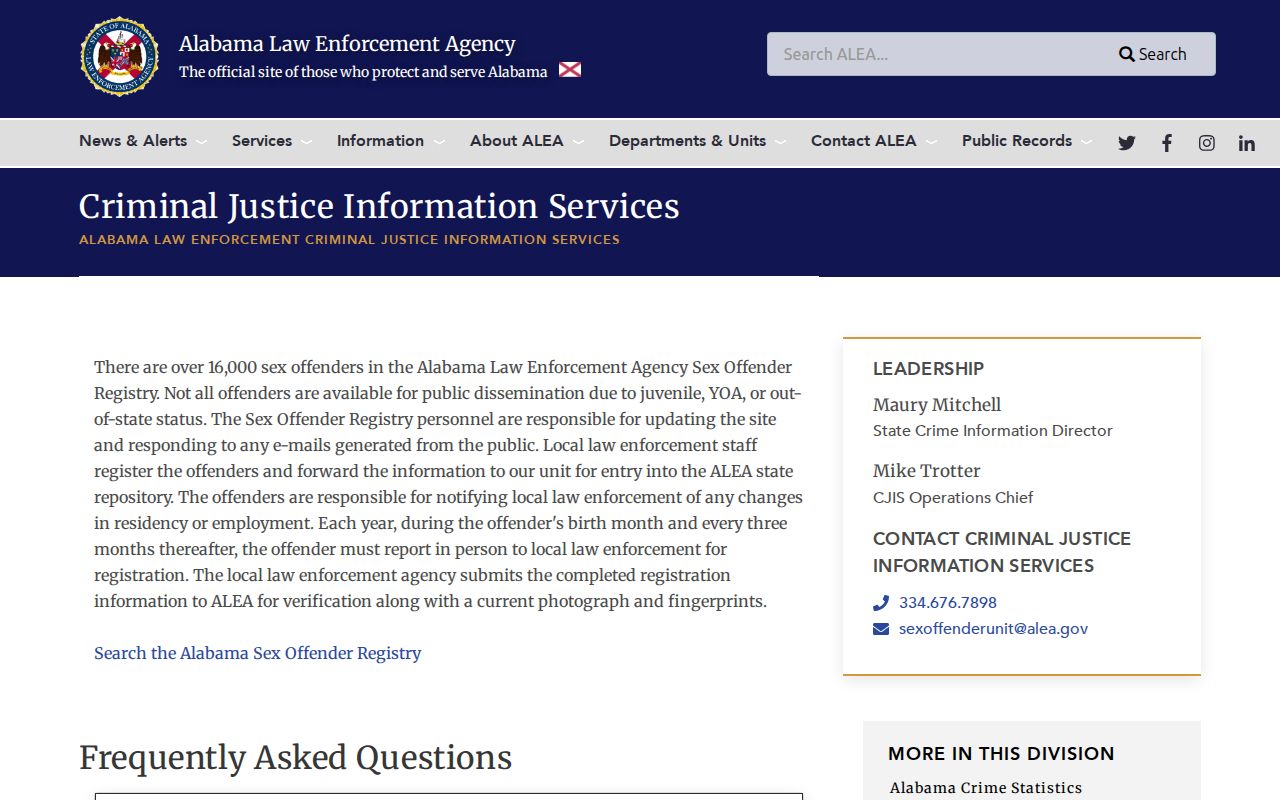
Public registry results have limits because some offenders are not publicly disseminated due to juvenile, Youthful Offender Act, or out-of-state status.
The ALEA service page links to registry and Community Information Center resources.
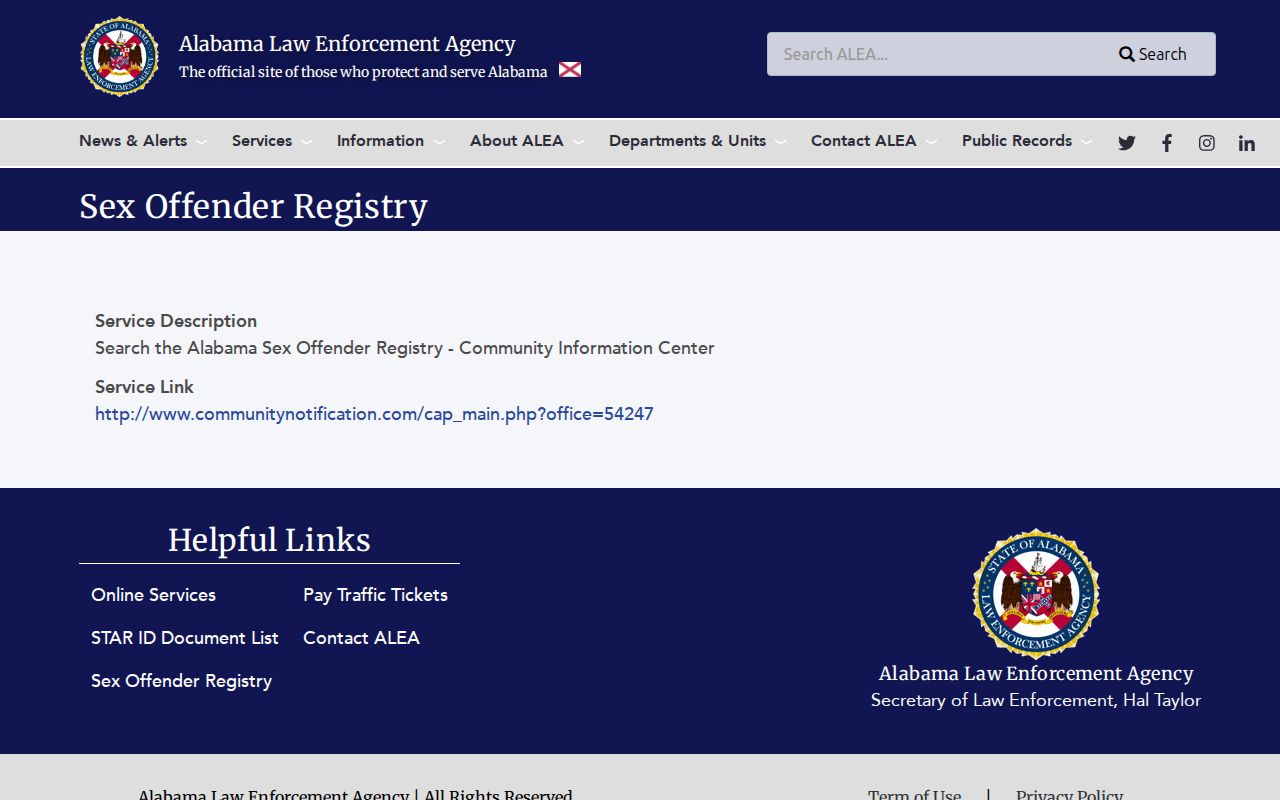
Use ALEA as a supplemental statewide tool, then verify local charges through Autauga court records and local custody through the sheriff.
Expungement and Public Access Limits
Alabama public-record law supports inspection and copying of public writings unless another statute limits access. For court records, the practical path starts with the record custodian: the Circuit Clerk for Circuit and District Court cases, and the sheriff for booking or incident records. Juvenile, adoption, mental health, sealed, expunged, and privacy-redacted material should not be treated as ordinary public information.
| Sealed / Restricted | Expunged | |
|---|---|---|
| Visibility | Hidden or limited by court order, statute, confidentiality, or redaction | Restricted from ordinary public access after an eligible petition is granted |
| Examples | Juvenile, sealed case images, ongoing investigations, sensitive identifiers | Eligible Alabama criminal records under expungement law |
| Autauga Filing Note | Ask the Circuit Clerk how restricted images or certified copies are handled | Research lists a Circuit Civil petition of expungement filing fee of $296 |
| Practical Effect | Some users or agencies may still have limited authorized access | Record custodians must process the court order; it is not instant deletion everywhere |
A person seeking expungement should identify whether the record is Circuit Criminal, District Criminal, or traffic/criminal, then review eligibility under Alabama expungement law, including Ala. Code Section 15-27-2. Gather the case number, charge, disposition, arresting agency, and certified disposition before filing. The clerk can process filings and copies but cannot give legal advice.
Background Check Considerations
Casual court lookup is different from an FCRA-regulated background check. Public court results may show charges that were later dismissed, amended, or expunged. They may omit restricted juvenile records, sealed images, or nonpublic identifiers. They may also lag behind clerk updates. For employment, housing, credit, insurance, or other regulated decisions, use legally compliant consumer-reporting procedures and verify records with the originating court or agency.
Important: This website is not a consumer reporting agency and cannot be used for FCRA-regulated screening decisions.